Booking event security looks simple until you start comparing quotes. One provider quotes an hourly rate, another quotes a flat fee, a third asks how many crowd controllers you need, and none of them explain why the numbers are different. If you need to hire event security Melbourne organisers can rely on, the safest approach is to follow a clear process: define your risks, work out staffing numbers, verify licences, compare itemised quotes and lock in the details in writing. This step-by-step guide covers each stage using current Victorian rules, so you can book with confidence whether you are running a wedding, a corporate function, a venue night or a community festival.
Before You Start: What Event Security Actually Covers
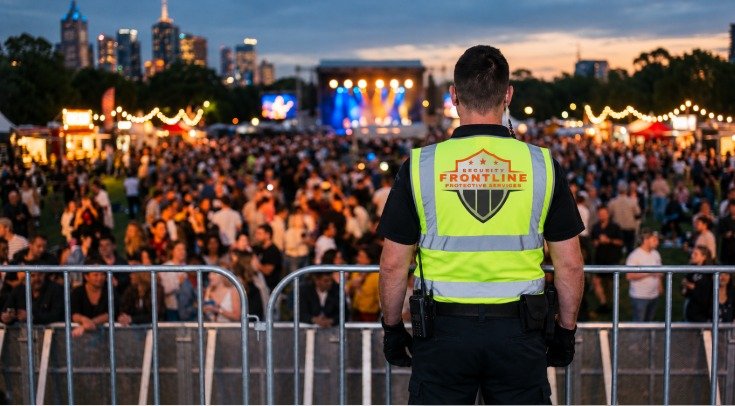
Event security is more than people standing at the door. Depending on your event, a provider may handle entry and exit control, guest list and access checks, crowd management, patrols of the venue and car park, protection of equipment during bump-in and bump-out, and the first response when something goes wrong. Frontline Protective Services offers event security in Melbourne alongside security guards and mobile security patrols, so one provider can cover the event itself and the site around it.
The rules matter because the stakes are real. Victoria Police regulates private security in Victoria under the Private Security Act 2004, and both the security business and each individual guard must hold a valid licence. Hiring someone who is not correctly licensed can expose you, your venue and your insurance to problems, which is why checking licences sits at the heart of this guide.
Step 1: Define Your Event and Its Risks
Start by writing down what you are organising and what could go wrong. Councils across Melbourne ask organisers to consider the size and type of the event, the age and demographics of guests, whether alcohol is served, whether there is overnight infrastructure on site, how close the event is to homes and businesses, and whether similar events have had problems before. Add practical details such as the venue layout, the number of entry points, the finish time and where cash, stock or valuable equipment will be held.
A one-page summary with your date, venue, expected numbers, alcohol arrangements and opening and closing times gives every provider the same information, which makes the quotes you receive far easier to compare.
Step 2: Work Out How Many Guards You Need
If alcohol is served, your liquor licence conditions decide whether licensed crowd controllers are required and where they must be positioned. The Victorian Government gives the standard ratio as two crowd controllers for the first 100 customers, plus one for every additional 100 customers or part thereof. With 240 customers, for example, you would need four crowd controllers. Yarra City Council describes the same pattern for most licensed events and notes that Victoria Police and the liquor regulator can set higher numbers where they see greater risk.
Treat that ratio as a minimum, not a target. Research from the Australian Institute of Criminology, based on about 50 interviews with police, liquor licensing authorities, security firms and councils in cities including Melbourne and Geelong, found that the right number depends on a range of risk factors rather than a single formula. A late finish, a single entry gate, free drinks or a younger crowd are all reasons to ask a provider whether extra staff are sensible.
You may also need people beyond crowd controllers, such as guards for car parks, back-of-house areas and equipment storage. Our guide to planning event security services in Melbourne explains how these roles fit into a full security plan.
Step 3: Shortlist Providers That Suit Your Event
Shortlist two or three providers rather than relying on a single quote. Look for evidence of experience with events like yours, because a team that regularly works weddings and venue nights handles guests very differently from a team used to guarding empty building sites. Boroondara Council’s event guidance encourages organisers to ask providers for references and for evidence of previous council approvals, and notes that around 85% of the industry belongs to the Australian Security Industry Association Limited (ASIAL), so membership is worth asking about even though it is not a legal requirement.
Location matters too. A provider based close to your venue can adjust numbers at short notice and reach the site quickly. Frontline Protective Services is based at 4/121 Fairbairn Road, Sunshine West, and operates 24/7 across Melbourne, which suits events in the west as well as the CBD and surrounding suburbs. If you are comparing providers more broadly, see our guide to the top security companies in Melbourne.
Step 4: Verify the Licences Before You Sign
Check the business and every guard
Ask each provider for its private security business licence number, then ask for the licence numbers of the staff who will attend. You can check them yourself on the Victoria Police public register, which shows whether a licence is valid and which activities the holder is eligible to perform. Licensing has changed recently, so some registrations remain valid beyond 19 June 2026 while transition applications are finalised. A genuine provider will help you with this check rather than avoid it.
Confirm crowd control is covered separately
A security guard licence alone does not allow someone to work as a crowd controller in Victoria. Crowd control is its own licence activity, and Victoria Police lists the CPP20218 Certificate II in Security Operations, with 130 hours of face-to-face training recommended, as the qualification behind it. If your event serves alcohol or has a large crowd, ask the provider to confirm in writing that the staff rostered for your event hold the crowd control activity.
Ask about labour hire licensing
This is the check most organisers miss. The Labour Hire Authority states that a security company supplying guards or crowd controllers to a host business is a labour hire provider, and that a private security licence does not replace a labour hire licence. Hosts must only engage licensed labour hire providers, and should confirm that any subcontractors the provider uses are licensed too. Penalties for using unlicensed labour hire services can exceed $660,000 for a corporation, according to the Authority. The definition of labour hire services also changed from 1 October 2026, so ask your provider how it applies to your arrangement. You can check a provider on the Labour Hire Authority’s licence register.
Step 5: Ask for the Right Documents
Once a provider passes the licence check, ask for the documents that show how they will actually run your event. Council event guidance across Melbourne expects the security contractor to supply a written Security Management Plan covering staffing levels and shift schedules, patrol areas and responsibilities, escalation procedures, communication systems and how incidents will be handled. Larger events may also need a Crowd Management Plan and an Emergency Management Plan, covering capacity limits, entry and exit flow, queue management, evacuation routes and assembly points.
Also ask for proof of public liability insurance and workers compensation cover, and check that the cover suits the size of your event. If a provider cannot produce a plan or insurance documents, treat that as a warning sign.
Step 6: Compare Quotes Like for Like
What drives the price
Event security is priced around staffing, so the main drivers are the number of guards and crowd controllers, the length of the shift, the time of day and the risk level. Award rules push the cost up at certain times. The Fair Work Ombudsman states that under the Security Services Award, night work from 6pm to 6am, Monday to Friday, is paid at 121.7% of the minimum hourly rate for full-time and part-time employees and 146.7% for casuals, and permanent night work rates are higher again. Weekends and public holidays carry their own loadings, which is why Friday night and Saturday events often cost more than weekday events.
Other items that can appear on a quote include supervisors, vehicles, radios, site visits before the event, and written reports. Most providers also set a minimum shift length, so a short event may still be charged for a longer booking.
Use a simple comparison table
Ask each provider to quote on the same basis, then compare them side by side.
| Question | Provider A | Provider B |
|---|---|---|
| Number of guards and crowd controllers quoted | ||
| Hours charged, including minimum shift | ||
| Night, weekend and holiday loadings shown | ||
| Supervisor included | ||
| Business licence and labour hire licence checked | ||
| Written security plan supplied | ||
| Insurance proof supplied | ||
| Replacement guard if someone cancels |
The cheapest hourly rate often leaves out supervision, reporting or cover for no-shows, so compare scope as well as price. For more on how security is priced, see our guide to professional security guards for Melbourne businesses.
Step 7: Lock In the Contract Terms
Before you accept a quote, get the key points in writing. These include the number and type of staff, their licence activities, start and finish times, the site address and areas covered, who supervises the team, who the guards report to, how incidents are recorded, what happens if a guard does not arrive, and the cancellation and notice terms. Agree in advance who calls emergency services and who has authority to ask someone to leave. Clear terms at this stage prevent most disputes later.
Step 8: Brief the Team Before Doors Open
Councils recommend that a representative of the security team attends planning briefings, and that the on-the-day briefing covers entry and exit locations, site hazards, emergency procedures, radio channels and how incidents are escalated and reported. A short briefing at the venue, a walk of the site and a handover of the guest list and key contacts remove most confusion once guests start to arrive.
Step 9: Review the Event Afterwards
Ask for an incident report within a few days of the event and note what worked and what to change next time. If your event involved build time the day before or pack-down after it, check whether overnight cover was needed. Mobile patrols, alarm response and asset protection security are common add-ons for stages, marquees and equipment left on site, and CCTV monitoring can help on larger sites.
Suggested Hiring Timeline
| When | What to do |
|---|---|
| About 3 months before (large or alcohol-heavy events) | Apply for any required liquor licence and council permit. Major Event Liquor Licence approval alone can take 9 to 11 weeks. |
| 6 to 8 weeks before | Write your event summary, request quotes and verify licences. |
| 4 weeks before | Choose a provider, review the security plan and sign the contract. |
| 1 week before | Confirm numbers, positions, shift times and contacts. |
| Event day | Hold the briefing and walk the site together. |
| Within a few days after | Review the incident report and give feedback. |
These timeframes are a practical guide, not a legal requirement. The Major Event Liquor Licence applies when you expect 5,000 or more attendees, and Business.gov.au advises applying about three months ahead. Confirm deadlines with your council and venue first.
Red Flags When Hiring Event Security
Be cautious if a provider will not give you licence numbers, cannot explain which licence activities its staff hold, has no written plan, quotes far below everyone else without explaining why, asks for full payment with no contract, or cannot name a supervisor. Another warning sign is a provider that promises the same team will attend but will not put staffing numbers in writing. Any of these is a good reason to keep looking.
Frequently Asked Questions
How do I hire event security in Melbourne?
Define your event and risks, work out the number of guards and crowd controllers you need, shortlist two or three licensed providers, verify their licences, compare itemised quotes, put the terms in writing and brief the team before the event.
How do I check that event security staff are licensed?
Search the Victoria Police public register for the business and each guard, and ask for the licence number of every person rostered. For crowd control, confirm the crowd control activity specifically. Also ask whether the provider holds a labour hire licence.
How many security guards do I need for an event?
For licensed events with alcohol, the standard ratio is two crowd controllers for the first 100 customers and one more for every additional 100 customers or part thereof. A risk assessment may justify more.
How much notice do I need to give?
As early as your date is confirmed. Large events and those needing a Major Event Liquor Licence should start planning about three months ahead, because approval can take 9 to 11 weeks.
Why are weekend and night events more expensive?
Under the Security Services Award, night and weekend work attracts penalty rates. For example, night work from 6pm to 6am, Monday to Friday, is paid at 121.7% of the minimum hourly rate for full-time and part-time staff and 146.7% for casuals.
Can Frontline Protective Services provide event security in Melbourne?
Yes. Frontline is based in Sunshine West and provides security across Melbourne. Contact the team with your date, venue and expected numbers to confirm availability and a quote.
Useful Resources
- Victoria Police: Public register of licence holders
- Victoria Police: Eligibility requirements and training for private security licences
- Victorian Government: Security at licensed venues and crowd controller ratios
- Labour Hire Authority: Labour hire in the security industry
- Fair Work Ombudsman: Night work penalty rates in the Security Award
- Yarra City Council: Event planning toolkit, security and crowd control
- Boroondara Council: Security and crowd management for events
- Business.gov.au: Major Event Liquor Licence (Victoria)
- Australian Institute of Criminology: An empirical basis for the ratio of crowd controllers to patrons
Final Thoughts on Hiring Event Security in Melbourne
Hiring event security well comes down to a few habits: start early, know your numbers, verify licences yourself, compare itemised quotes and get every promise in writing. Do that and your guests will notice a safe, well-run event rather than the security behind it.
To plan security for your next event, call Frontline Protective Services on 1300 020 030 or request a free consultation. Tell us the date, venue, expected numbers and whether alcohol will be served, and we will put together a plan and quote. You can also read more about our team, browse our security services or see the industries we support.
3 Comments
[…] For a full planning guide, read our article on how to plan event security services in Melbourne and our guide on how to hire event security in Melbourne. […]
[…] requests often cost more. Our guide on how to hire event security in Melbourne explains the timeline, ratios and licence checks, and our guide to event security planning in […]
[…] quote on the same basis, and compare scope as well as price. For a full process, read our guide on how to hire event security in Melbourne, and for a planning timeline see how to plan event security services in Melbourne. To see how […]