

A construction site is one of the easiest places in Melbourne to steal from and one of the hardest to keep safe. Tools, copper, fuel, plant and materials sit on open ground, the site is empty every night and weekend, and new estates in the west are often far from passing traffic. If you are looking for the best construction site security Melbourne builders can rely on, the answer is not a single product. It is a layered plan: proper fencing, lighting, monitoring, patrols and licensed guards, matched to the stage of your build and the risks around it. This guide explains what Victorian law expects, what each security option does, what it costs to get wrong and how to choose a provider you can verify.
Why Melbourne Construction Sites Are Targeted
Thieves go where the goods are easy to move and easy to sell. Tools and equipment are the main target, and the numbers are large. A media release from RACV, citing Crime Statistics Agency data, reported that tool theft costs Victorian tradies about $20 million a year, with more than 29,000 tools reported stolen in the 12 months to March 2023. Those figures cover tradies broadly, not only building sites, but they show the scale of the problem for anyone leaving tools on a site overnight.
Growth adds to the exposure. Melbourne’s western suburbs are some of the busiest building corridors in the country. Point Cook alone recorded 66,775 residents at the 2021 census, with households up 33% since 2016, and Wyndham projects the suburb will reach 81,966 people by 2040. Each new street means more sites in various stages, many without finished fences, lighting or neighbours watching.
The wider crime picture is mixed. Victoria recorded 624,624 offences in the 12 months to June 2026, a 2.1% drop, and overall burglary offences fell 19.9%. Theft from motor vehicles, however, made up 12.4% of all recorded crime, and retail theft rose 2.7% to 43,124 offences. Falling totals do not remove the risk of opportunistic theft from an unattended site.
What Victorian Law Expects From Builders
Safety duties continue when work stops
Security is not only about theft. Under the Occupational Health and Safety Act 2004, a person with management or control of a workplace, such as a builder, must ensure, so far as is reasonably practicable, that the workplace and its entry and exit points are safe. WorkSafe Victoria states that this duty applies even when no work is happening, including outside working hours, and that it extends to members of the public who may enter an unoccupied site. WorkSafe also asks employers to consider children entering unoccupied sites, particularly near schools, parks and built-up areas.
Fencing comes first, guards come second
WorkSafe Victoria describes temporary security fencing as the most accepted industry method for controlling entry and exit. Its guidance says fencing should be at least 1.8 metres high, well constructed with secure gates and joints, stable enough to handle expected loads such as strong wind, and difficult to climb or get under. Sheets of reinforcing mesh should not be used, because children can climb them and protruding ends can cause injury. The same guidance says surveillance by security personnel should only be used for short periods where fencing is not reasonably practicable.
That means guards and patrols are not a replacement for a proper fence. The strongest plan uses fencing as the physical barrier and security services as the layer that detects, deters and responds.
Victoria Police advice for construction sites
Victoria Police’s construction theft advice recommends locking buildings and storage containers, installing CCTV, audible alarms and good lighting, and employing a guard service. It also suggests engraving or painting tools with a driver’s licence number or other unique mark, photographing equipment and recording model and serial numbers, locking tools away overnight, removing batteries at night to disable equipment and keeping records of materials moving on and off the site. Read the full advice on the Victoria Police construction site theft page.
Construction Site Security Options Compared
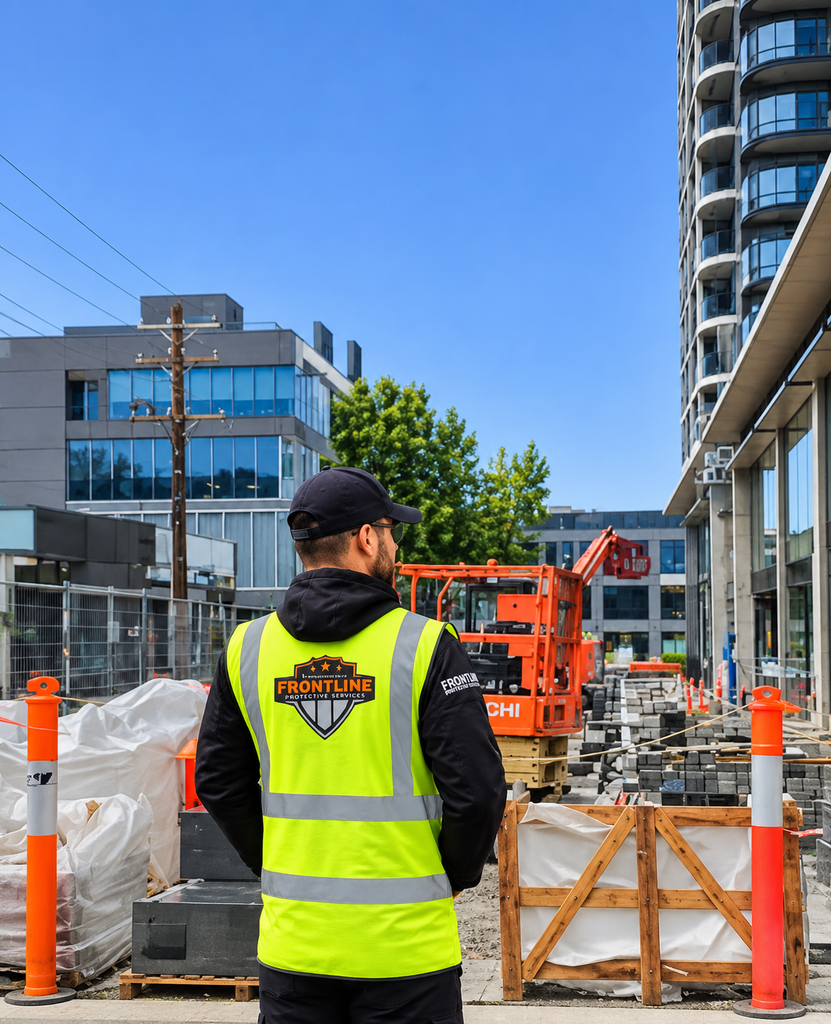
The right mix depends on your site size, location and stage. Frontline Protective Services provides construction site security in Melbourne alongside the other services below, so they can be combined on one contract.
| Option | What it does | Best for |
|---|---|---|
| Temporary security fencing | Physical barrier and legal baseline for site safety | Every site, before anything else |
| Static security guards | Controls the gate, checks deliveries, logs vehicles and visitors | Large sites, high-value stock, busy periods |
| Mobile security patrols | Scheduled or randomised visits, checks fences, gates and storage | Small and medium sites, overnight and weekend cover |
| CCTV monitoring | Cameras with live or recorded monitoring | Sites with long perimeters or limited lighting |
| Alarm response | Guard attends when an alarm or sensor triggers | Sites with alarms on site sheds and containers |
| Asset protection security | Protects plant, machinery and stored materials | Sites holding expensive equipment |
Guards or patrols?
A static guard stays at one location, so they suit sites that need constant control of who comes and goes. A mobile patrol visits one or more sites in a marked vehicle and usually costs less for sites that only need after-hours checks. Many builders use a guard during delivery-heavy stages and switch to patrols and monitored alarms once the building is locked up.
How to Choose the Best Construction Site Security Company in Melbourne
1. Verify the business and every guard
The Licensing and Regulation Division of Victoria Police regulates private security in Victoria. The business and each guard must hold a valid licence for the work they perform. Check both on the Victoria Police public register, which shows whether a licence is valid and which activities the holder is eligible to perform. Licensing has changed recently, so some registrations remain valid beyond 19 June 2026 while transition applications are finalised.
2. Check site safety and induction
Guards working on a building site need to follow your site rules. Ask how the provider briefs guards on hazards, exclusion zones, emergency procedures and induction requirements, and whether it can meet the contractor compliance system your head contractor uses. Some providers list contractor compliance certification on their websites, so ask to see the evidence.
3. Look for local response
Distance affects how fast someone reaches your gate. A provider based in Melbourne’s west can reach sites in Truganina, Tarneit, Werribee, Point Cook and Wyndham Vale faster than one starting from the other side of the city. Frontline Protective Services is based at 4/121 Fairbairn Road, Sunshine West, and operates 24/7 across Melbourne. See our guide to security companies in Western Melbourne for more on what to look for in the west.
4. Demand clear reporting
You should receive written shift or patrol reports with time-stamped visits, notes on what the guard found and photos where relevant. Reports help you update your insurer and police after an incident, and they show whether the same gate or time window keeps appearing.
5. Confirm insurance and supervision
Ask for current public liability and workers compensation certificates, and check that the cover suits the size of your site. Ask who supervises night shifts, and what happens if a guard does not arrive.
6. Compare itemised quotes
Security is priced around the type of service, the hours, the site and the risk. Award rules also affect cost. The Fair Work Ombudsman states that under the Security Services Award, night work from 6pm to 6am, Monday to Friday, is paid at 121.7% of the minimum hourly rate for full-time and part-time employees and 146.7% for casuals, and weekends and public holidays carry their own loadings. Ask for a quote that shows supervision, vehicles, reporting, minimum shift lengths and replacement guards, so a low hourly rate does not hide missing extras. Our guide to the best security company in Melbourne includes a scorecard you can use to compare providers.
Build a Site Security Plan, Step by Step
Step 1: Assess the site
Walk the site and list entry points, blind spots, lighting, neighbours, storage locations and the value of what is kept on site. Note nearby schools, parks and homes, because WorkSafe asks builders to consider children entering unoccupied sites.
Step 2: Fix the basics
Install compliant fencing at least 1.8 metres high, lock gates, store tools in locked containers, light the site and remove batteries from equipment at night.
Step 3: Add detection
Install CCTV and audible alarms, and arrange for alarm response, so someone attends when a sensor triggers.
Step 4: Add people
Choose guards for delivery-heavy and high-risk stages, and mobile patrols for overnight and weekend cover. Match the number of visits to your risk, not just to your budget.
Step 5: Plan for shutdown periods
Weekends, public holidays and the Christmas break leave sites empty for long stretches, and WorkSafe Victoria has issued reminders for builders to secure sites before the break. Increase patrols, check fences and remove anything portable before you leave.
Step 6: Record and review
Keep an inventory with serial numbers and photos, record deliveries and review patrol reports regularly. Update the plan as the build moves from excavation to frame to fit-out.
What to Do After a Theft or Break-In
Victoria Police advises that if you are at the site during a burglary, you should not confront the thief, you should leave or find a safe place, you should not touch anything at the scene and you should call your insurer. For non-emergencies, use Victoria Police’s online reporting or call the Police Assistance Line on 131 444. Neighbours can report suspicious activity to Crime Stoppers on 1800 333 000.
Red Flags When Hiring Construction Site Security
Be cautious if a provider will not give licence numbers, cannot explain its labour hire status, has no sample report, quotes far below others without explaining why, cannot name a night supervisor or offers guards as a replacement for site fencing. Another warning sign is a provider that cannot explain what it does when an alarm triggers and a guard is already on another job.
Frequently Asked Questions
What is the best security for a construction site in Melbourne?
There is no single best option. The most effective approach is layered: compliant fencing, locked storage, lighting, CCTV and alarms, plus licensed guards or mobile patrols matched to your site size and stage.
Do I need security guards on a construction site in Victoria?
Not always. WorkSafe Victoria’s guidance treats compliant fencing as the standard control and says security personnel should only be used for short periods where fencing is not reasonably practicable. Guards and patrols are still widely used to reduce theft and to monitor sites after hours.
How high should construction site fencing be?
WorkSafe Victoria’s guidance says security fencing should be at least 1.8 metres high, well constructed, stable in wind and difficult to climb or get under.
How much does construction site security cost in Melbourne?
Cost depends on the service, the hours, the site size and the risk. Night and weekend work attracts penalty rates under the Security Services Award, with night work from 6pm to 6am, Monday to Friday, paid at 121.7% of the minimum hourly rate for full-time and part-time staff and 146.7% for casuals. Ask for an itemised quote.
How do I check that a construction site security company is licensed?
Search the Victoria Police public register for the business and ask for the licence number of every guard assigned to your site. Also ask whether the provider holds a labour hire licence.
Does Frontline Protective Services provide construction site security in Melbourne?
Yes. Frontline is based in Sunshine West and provides construction site security across Melbourne, including the west. Contact the team with your site address, stage and hours to arrange an assessment and quote.
Useful Resources
- WorkSafe Victoria: Construction site security fencing
- WorkSafe Victoria: Site security and public access onto housing construction sites
- Victoria Police: Preventing construction site theft
- RACV: Tool theft costing Victorian tradies $20m a year
- Victoria Police: Public register of licence holders
- Labour Hire Authority: Labour hire in the security industry
- Fair Work Ombudsman: Night work penalty rates in the Security Award
- Wyndham City: Point Cook suburb infographic (2021 census)
Final Thoughts on Construction Site Security in Melbourne
The best construction site security is layered, documented and verifiable. Start with compliant fencing and locked storage, add lighting and monitoring, then bring in licensed guards or patrols that match your risks. Ask every provider for evidence of licences, insurance and reporting, and compare itemised quotes before you decide.
To talk through your site, call Frontline Protective Services on 1300 020 030 or request a free consultation. You can also read more about our team, browse our security services or see the industries we support.