A well-run event feels effortless to guests, and that is usually because someone planned the security long before the doors opened. Whether you are organising a wedding in Sunshine, a warehouse launch in Derrimut, a festival in a Footscray park or a corporate night in the CBD, the right event security services Melbourne organisers book will affect safety, licensing, insurance and how the night is remembered. This guide walks through what Victorian rules require, how many guards you are likely to need, what a proper security plan contains and how to choose a provider you can trust, so you can plan with facts rather than guesswork.
Why Event Security Planning Matters in Melbourne
Melbourne runs one of the busiest event calendars in Australia, from major sporting and cultural events to community festivals, private functions and venue nights across the western suburbs. Every one of them carries similar risks: crowd build-up at entry points, intoxicated guests, gate-crashers, theft, disputes and the need to evacuate quickly if something goes wrong.
Councils and regulators expect organisers to think about these risks early. City councils across Melbourne ask organisers to assess the event’s size, type, attendee age and demographics, alcohol service, overnight infrastructure on site, proximity to homes and businesses, and the history of similar events when deciding whether security is needed. In practice, if your event involves alcohol, a large crowd, valuable equipment or crowd movement such as parades or fireworks, you should assume that licensed security will be part of your approval conversation.
Good planning also protects you commercially. A venue or council that sees a clear security plan is far more likely to approve your event, and an insurer is far more likely to treat an incident as a managed risk rather than an avoidable failure.
Know the Victorian Rules Before You Book
Security businesses and guards must be licensed
Private security in Victoria is regulated by the Licensing and Regulation Division of Victoria Police under the Private Security Act 2004. Both the security business and each individual working for it must hold a valid Victoria Police licence. Councils such as Boroondara state this directly in their event guidance, and they point organisers to the Victoria Police website to verify licences. You can do the same check yourself on the Victoria Police private security page before you sign anything.
A guard licence is not a crowd controller licence
This is the point many first-time organisers miss. Yarra City Council’s event toolkit is clear that a security guard licence alone does not allow someone to work as a crowd controller. Crowd control is its own licence activity. Victoria Police lists the training for it as the CPP20218 Certificate II in Security Operations, with 130 hours of face-to-face training recommended, covering monitoring and controlling individual and crowd behaviour, removing people from premises, managing intoxicated persons, basic defensive techniques and first aid. Applicants must be at least 18, pass a fit and proper person assessment and provide fingerprints and identification. Ask your provider to confirm in writing that the staff rostered for your event hold the correct licence activity, not just a general guard licence.
How many crowd controllers do you need?
If alcohol is served, your liquor licence conditions decide whether crowd controllers are mandatory and where they must be positioned. The Victorian Government’s guidance for licensed venues gives the standard ratio as two crowd controllers for the first 100 customers, plus one for every additional 100 customers or part thereof. For example, with 240 customers you would need four crowd controllers. Yarra City Council describes the same pattern for most licensed events, and notes that Victoria Police and the liquor regulator can set the number where they see a higher risk.
The ratio is a minimum, not a recommendation. Research published by the Australian Institute of Criminology on crowd controller to patron ratios drew on about 50 interviews with police, liquor licensing authorities, security firms, councils and large venues in cities including Melbourne and Geelong. Its main conclusion is that the right number depends on a range of risk factors, which is why a site-specific risk assessment matters more than any single formula. Late finishes, a younger crowd, free drinks, a single entry gate or a history of problems can all justify extra staff above the minimum.
Licensed venues must also keep a register of crowd controllers that inspectors can access at any time, including when no manager is on site. Check that your security provider supplies the details you need to complete it.
Liquor licences and large events
If you plan to serve alcohol at an event with no existing liquor licence, you will usually need a temporary or event-specific licence, even if the drinks are free for invited guests. For very large events, the Major Event Liquor Licence applies when you expect 5,000 or more attendees, when close coordination with Victoria Police, council, public transport or emergency services is needed, or when roads are closed for a street festival. Business.gov.au advises applying about three months ahead, with approval taking 9 to 11 weeks. That timeline matters, because your security plan often needs to be ready before those approvals can be finalised.
Step-by-Step: How to Plan Your Event Security
Step 1: Start with a risk assessment
List what could realistically go wrong at your event. Consider the venue layout, the number and type of guests, whether alcohol is served, what time the event ends, how guests will arrive and leave, and where cash or valuable equipment is held. Neighbouring residents and businesses should be part of the picture too, particularly for outdoor events and venues near homes. A written assessment gives your security provider something concrete to price and plan against.
Step 2: Set the number and type of staff
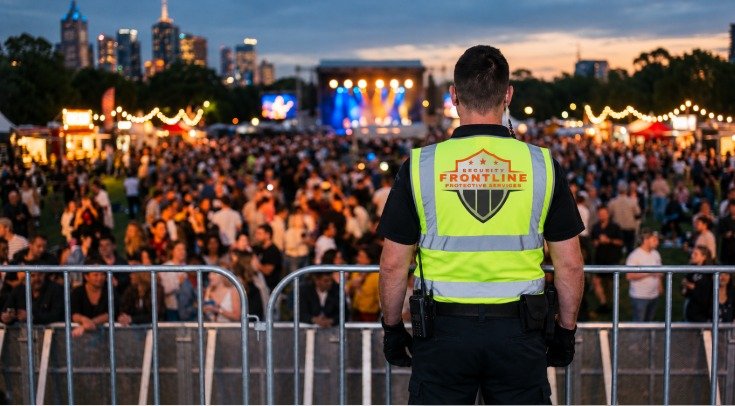
Match staff to the risks you identified. Entry points usually need guards who can check tickets, bags and guest lists. Licensed areas need crowd controllers in the numbers set by your licence conditions. Back-of-house areas, car parks and equipment storage often need separate coverage. For multi-day events or those with overnight infrastructure, you will need security after the guests have gone home as well.
Step 3: Ask for a Security Management Plan
Council event guidance across Melbourne expects the security contractor to provide a written plan that sets out staffing levels and shift schedules, patrol areas and responsibilities, escalation procedures, communication systems and how the team will respond to incidents. If a provider cannot produce this document, treat that as a warning sign.
Step 4: Prepare crowd and emergency management plans
Larger or higher-risk events may also need a Crowd Management Plan covering maximum capacity for each area, entry and exit flow, queue management, crowd density monitoring near stages and food areas, and communication through signage, PA announcements and roaming staff. An Emergency Management Plan should identify evacuation routes and assembly points, assign roles such as wardens, marshals and first aiders, and include accessible routes and support for guests with disability or additional needs. Your security team should know these plans in detail, not just receive a copy.
Step 5: Brief the team before doors open
Councils recommend that a representative of the security team attends the planning briefings, and that the on-the-day briefing covers entry and exit locations, site hazards, emergency procedures, radio channels and how incidents are escalated and reported. A ten-minute briefing at the venue prevents a lot of confusion once guests arrive.
Step 6: Plan communication with police, venue staff and organisers
Agree in advance who the guards report to, who calls emergency services and how the team communicates across large sites. For events with alcohol, security staff should be trained to remove an intoxicated person discreetly and safely, and to call police when that cannot be done. Clear lines of authority keep small problems from becoming incidents.
Suggested Planning Timeline
| When | What to do |
|---|---|
| About 3 months before (large or alcohol-heavy events) | Apply for any required liquor licence and council permit. Major Event Liquor Licence approval alone can take 9 to 11 weeks. |
| 6 to 8 weeks before | Complete the risk assessment, request quotes and book a licensed provider. |
| 3 to 4 weeks before | Receive and review the Security Management Plan. Finalise crowd and emergency plans. |
| 1 week before | Confirm numbers, positions, shift times and licence details. Share the site map and contact list. |
| Event day | Hold the pre-event briefing, check radios and walk the site together. |
| Within a few days after | Review the incident report and note what to improve next time. |
These timeframes are a practical guide, not a legal requirement. Your council or venue may ask for earlier lodgement, so confirm their deadlines first.
Choosing Event Security Services in Melbourne
Check licences and insurance
Ask for the business licence number, then confirm the individual licence activity for the staff who will attend. Yarra City Council advises engaging providers that are insured and qualified for their assigned roles, and asking for their private security business licence before you engage them. Request proof of public liability cover and workers compensation, and check that the cover suits the size of your event.
Look for relevant experience
Boroondara’s event guidance encourages organisers to check a provider’s experience with similar events and to ask for references or evidence of previous council approvals. A team that regularly works weddings, venue nights and corporate functions will handle your event differently from a team used to guarding empty building sites, and the same applies in reverse.
Consider industry membership
Boroondara’s guidance recommends membership of the Australian Security Industry Association Limited and notes that around 85% of the industry belongs to it. Membership is not a legal requirement, but it indicates a provider that keeps up with industry standards.
Choose a local team that can respond fast
For events in the west, a provider based nearby can adjust staffing quickly if your numbers change, bring extra people on short notice and reach the venue without delays. Frontline Protective Services is based at 4/121 Fairbairn Road, Sunshine West, and operates 24/7 across Melbourne. You can read more about our team or see our full range of security services.
Ask about additional support
Many events need more than staff at the door. Frontline provides event security for venues, functions and crowd management, and can add security guards for gates and reception, mobile security patrols for overnight checks of bump-in and bump-out sites, CCTV monitoring for larger sites and asset protection security for high-value equipment. Setting up a build in a venue the day before? Construction site security and alarm response are useful for stages, marquees and temporary structures left overnight. See which industries we support on our sectors page.
What Affects the Cost of Event Security?
Event security is priced around staffing, so the main drivers are the number of guards and crowd controllers, the length of the shift, the time of day and the risk level. Nights, weekends and public holidays attract penalty rates under the industry award, and events with alcohol or large crowds need more experienced, correctly licensed staff. Most providers also set minimum shift lengths, so a short event may still be charged for a longer booking. Supervisors, vehicles, radios, pre-event site visits and written reporting may be itemised separately, so ask for a quote that lists everything included. The cheapest hourly rate often leaves these items out, so compare the full scope rather than the headline price. For more on choosing a provider, see our guide to professional security guards for Melbourne businesses and our post on security companies in Western Melbourne.
Common Event Security Mistakes to Avoid
The most frequent mistake is booking too late, which leaves little time to confirm licences, brief the team or adjust numbers. The second is assuming any licensed guard can work as a crowd controller, which can put your licence conditions at risk. Others include ignoring the exit plan, forgetting about back-of-house and car park areas, not telling security about VIP guests or high-value items, and leaving the briefing until guests have already arrived. Each of these is easy to avoid with a written plan and a provider who asks the right questions upfront.
Frequently Asked Questions
Do I need licensed security for my event in Melbourne?
It depends on the event. If you serve alcohol, your liquor licence conditions will state whether licensed crowd controllers are required. For other events, councils and venues decide based on risk factors such as crowd size, alcohol, valuable equipment and the surrounding area. Any security staff you hire must hold the correct Victoria Police licence.
How many security guards do I need for an event?
For licensed events with alcohol, the standard ratio is two crowd controllers for the first 100 customers and one more for every additional 100 customers or part thereof. A risk assessment may justify more, depending on the crowd, finish time and site layout.
What is the difference between a security guard and a crowd controller?
Crowd control is a separate licence activity in Victoria. A standard security guard licence does not allow someone to work as a crowd controller, so ask your provider to confirm the licence activity for every person rostered.
How early should I book event security?
As early as your date is confirmed. For large events or those needing a Major Event Liquor Licence, applications are advised about three months ahead, and approvals can take 9 to 11 weeks, so security planning should start well before that point.
Can Frontline Protective Services provide event security in Melbourne’s west?
Yes. Frontline is based in Sunshine West and provides security across Melbourne. Contact the team with your date, venue and expected numbers to confirm availability and a quote.
Useful Resources
- Victoria Police: Private security (licensing and public register)
- Victoria Police: Eligibility requirements and training for private security licences
- Victorian Government: Security at licensed venues and crowd controller ratios
- Yarra City Council: Event planning toolkit, security and crowd control
- Boroondara Council: Security and crowd management for events
- Business.gov.au: Major Event Liquor Licence (Victoria)
- Australian Institute of Criminology: An empirical basis for the ratio of crowd controllers to patrons
- City of Melbourne: Event planning guide
Final Thoughts on Event Security Services in Melbourne
Effective event security comes down to starting early, understanding the Victorian licensing rules, putting your plans in writing and choosing a provider that can show current licences, relevant experience and a local base. Get those right and your guests will notice a safe, well-run event rather than the security behind it.
To plan security for your next event, call Frontline Protective Services on 1300 020 030 or request a free consultation. Tell us the date, venue, expected numbers and whether alcohol will be served, and we will put together a plan and quote.
1 Comment
[…] ask the provider to confirm the correct licence activity for every person rostered. Our guide on how to plan event security services in Melbourne explains the standard ratio of two crowd controllers for the first 100 patrons, plus one for every […]